Ready Mix Concrete (RMC) has become the backbone of modern construction due to its consistent quality, faster production, and cost-effective application. Understanding the complete process of concrete manufacturing is essential for entrepreneurs planning to establish an RMC plant and for contractors looking to ensure quality concrete supply.
As a leading RMC Plant Consulting Gujarat company, JSM Consultant provides complete Ready Mix Concrete Plant Setup Consultancy, helping investors, builders, infrastructure developers, and manufacturers establish successful RMC plants across Gujarat. As an experienced RMC Plant Consultant Gujarat, we offer end-to-end support including plant planning, machinery selection, statutory approvals, quality control systems, and project execution.
Whether you are looking for a Ready Mix Concrete Plant Consultant Ahmedabad, RMC Plant Consultant Surat, RMC Plant Consultant Vadodara, RMC Plant Consulting Gandhinagar, or RMC Plant Consulting Sanand, understanding the concrete production process is the first step toward building a successful Ready Mix Concrete business.
What is Ready Mix Concrete (RMC)?
Ready Mix Concrete (RMC) is factory-manufactured concrete produced in a batching plant under controlled conditions using accurately measured quantities of cement, water, fine aggregates, coarse aggregates, and chemical admixtures. The concrete is then transported to construction sites using transit mixers while maintaining its workability and quality.
With professional Concrete Plant Consulting Services and expert guidance from an RMC Plant Setup Consultant, businesses can ensure efficient production, reduced wastage, and consistent concrete quality.
Key Ingredients Used in Concrete Manufacturing
The strength and durability of concrete depend on the quality of raw materials used during production.
Cement
Cement acts as the primary binding material that holds all ingredients together and contributes to the overall strength of concrete.
Water
Water initiates the hydration process and provides the required workability for concrete placement and compaction.
Fine Aggregate (Sand)
Fine aggregates fill the voids between coarse aggregates and improve density and finish.
Coarse Aggregate (Stone)
Coarse aggregates provide structural strength and load-bearing capacity.
Chemical Admixtures
Admixtures enhance workability, setting time, durability, and concrete performance under various site conditions.
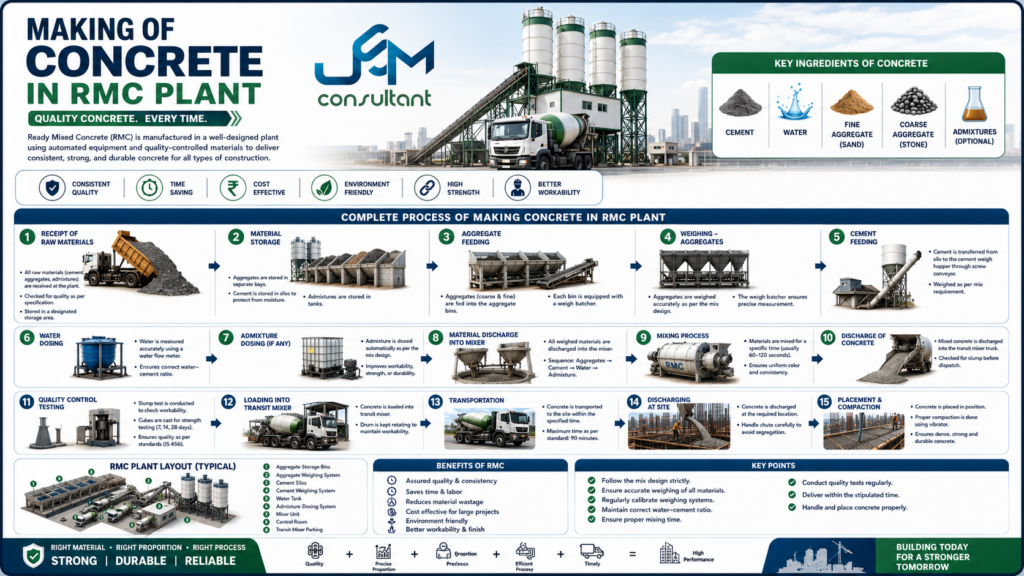
Complete Process of Making Concrete in an RMC Plant
Step 1: Receipt of Raw Materials
The manufacturing process begins with the procurement and receipt of quality-approved raw materials.
Materials received include:
- Cement
- Sand
- Stone Aggregates
- Water
- Chemical Admixtures
Before unloading, quality inspections are conducted to verify:
- Material quality
- Particle size
- Moisture content
- Supplier compliance
As part of professional RMC Plant Project Management, proper vendor selection and material testing play a critical role in maintaining concrete quality.
Step 2: Material Storage
After inspection, materials are stored in designated locations within the plant.
Cement Storage
Cement is stored in silos equipped with dust collectors and aeration systems to prevent moisture absorption.
Aggregate Storage
Fine and coarse aggregates are stored separately in aggregate bins.
Water Storage
Water is stored in dedicated tanks to ensure uninterrupted production.
Admixture Storage
Chemical admixtures are stored in specialized tanks and dosing systems.
A properly planned storage system is an important component of RMC Plant Layout Design, ensuring smooth material flow and efficient operations.
Step 3: Aggregate Feeding
Aggregates are transferred from storage bins to the batching section using conveyor belts or feeding hoppers.
Separate compartments ensure:
- Accurate material segregation
- Reduced contamination
- Efficient production
Professional Batching Plant Consultants Gujarat carefully design aggregate handling systems to maximize productivity.
Step 4: Weighing of Aggregates
The aggregates are weighed automatically according to the approved mix design.
Accurate weighing is essential because even small variations can significantly affect:
- Concrete strength
- Workability
- Durability
Modern batching plants use computerized weighing systems to maintain precision.
Step 5: Cement Feeding
Cement is transported from silos to weighing hoppers using screw conveyors.
The system automatically measures the required cement quantity according to the mix design.
Proper cement proportioning ensures:
- Desired compressive strength
- Uniform quality
- Long-term durability
Step 6: Water Dosing
Water is measured through automated flow meters and dosing systems.
Maintaining the correct water-cement ratio is critical because it directly influences:
- Strength
- Workability
- Durability
- Setting characteristics
Experienced Ready Mix Concrete Consultants Gujarat emphasize strict water control as part of quality assurance.
Step 7: Admixture Dosing
Depending on project requirements, chemical admixtures are added automatically.
Common admixtures include:
- Plasticizers
- Superplasticizers
- Accelerators
- Retarders
- Waterproofing Chemicals
These improve concrete performance and site workability.
Step 8: Material Discharge into Mixer
After weighing, all ingredients are discharged into the mixer in a predetermined sequence.
Typical sequence:
- Aggregates
- Cement
- Water
- Admixtures
Proper sequencing ensures uniform mixing and consistent quality.
Step 9: Mixing Process
The mixer thoroughly blends all materials to create homogeneous concrete.
Mixing duration generally ranges from:
30 to 120 seconds
depending on plant type and mix requirements.
The mixing process ensures:
- Uniform consistency
- Proper coating of aggregates
- Desired workability
- Consistent strength
This stage is a key focus area for every RMC Plant Machinery Consultant when selecting batching plant equipment.
Step 10: Concrete Discharge
After mixing, concrete is discharged into transit mixers.
The concrete is visually inspected before dispatch to ensure:
- Uniform consistency
- Proper slump
- No segregation
Step 11: Quality Control Testing
Every professional RMC plant follows strict quality control procedures.
Slump Test
Measures workability and consistency.
Cube Casting
Samples are cast for compressive strength testing.
Compressive Strength Test
Conducted at:
- 7 Days
- 14 Days
- 28 Days
Moisture Testing
Ensures accurate aggregate moisture correction.
Quality control systems are essential components of successful RMC Plant Project Consulting.
Step 12: Loading into Transit Mixers
Concrete is loaded into transit mixer trucks.
The drum rotates continuously to prevent segregation during transportation.
Step 13: Transportation to Construction Site
Concrete is delivered to project locations within specified time limits.
Benefits include:
- Reduced site storage
- Faster construction
- Improved project scheduling
Proper logistics planning is an important part of RMC Plant Project Management.
Step 14: Discharging at Site
Upon arrival, concrete is discharged using:
- Chutes
- Concrete Pumps
- Placement Equipment
Site engineers verify:
- Slump
- Mix consistency
- Delivery time
before placement.
Step 15: Placement and Compaction
Concrete is placed into formwork and compacted using vibrators.
Proper compaction:
- Eliminates air voids
- Increases density
- Enhances strength
- Improves durability
This final stage determines the long-term performance of the structure.
Benefits of Ready Mix Concrete
Using RMC offers several advantages:
✔ Consistent Quality
✔ Better Strength
✔ Reduced Material Wastage
✔ Faster Construction
✔ Lower Labour Costs
✔ Improved Workability
✔ Environment-Friendly Operations
✔ Better Surface Finish
✔ Higher Productivity
Why Choose JSM Consultant?
JSM Consultant is a trusted RMC Plant Consultant Gujarat offering complete Ready Mix Concrete Plant Setup Consultancy and RMC Plant Setup Services Gujarat. Our team of experienced RMC Plant Project Consultants, Batching Plant Consultants Gujarat, and RMC Plant Machinery Consultants provides complete assistance for land selection, feasibility studies, RMC Plant Layout Design, machinery procurement, GPCB approvals, Factory Licence Registration, CGWA NOC, ISO Certification, subsidy consultancy, and operational planning.
We proudly serve clients across Ahmedabad, Gandhinagar, Sanand, Vadodara, Surat, Bharuch, Rajkot, Jamnagar, Morbi, Bhavnagar, Anand, and all major industrial locations in Gujarat.
Whether you need a Ready Mix Concrete Plant Consultant Ahmedabad, RMC Plant Consultant Surat, RMC Plant Consultant Vadodara, RMC Plant Consulting Gandhinagar, or RMC Plant Consulting Sanand, JSM Consultant delivers professional, practical, and compliance-focused solutions for successful RMC plant establishment and growth.