Choosing the right batching plant is one of the most important decisions when setting up a Ready Mix Concrete (RMC) business. The type of batching plant directly impacts production capacity, concrete quality, project efficiency, operational costs, and long-term profitability.
Whether you are planning an RMC plant in Ahmedabad, Gandhinagar, Sanand, Vadodara, Surat, Bharuch, Rajkot, or anywhere in Gujarat, understanding the different types of batching plants helps ensure the right investment for your project requirements.
JSM Consultant provides complete RMC Plant Consulting Gujarat, Ready Mix Concrete Plant Setup Consultancy, RMC Plant Layout Design, Machinery Selection Support, and RMC Plant Project Management Services across Gujarat.
What is a Batching Plant?
A batching plant is a facility where cement, aggregates, sand, water, and admixtures are accurately measured and mixed to produce high-quality Ready Mix Concrete (RMC).
Modern batching plants ensure:
- Consistent Concrete Quality
- Accurate Material Proportioning
- Faster Production
- Reduced Material Wastage
- Improved Construction Efficiency
Types of Batching Plants
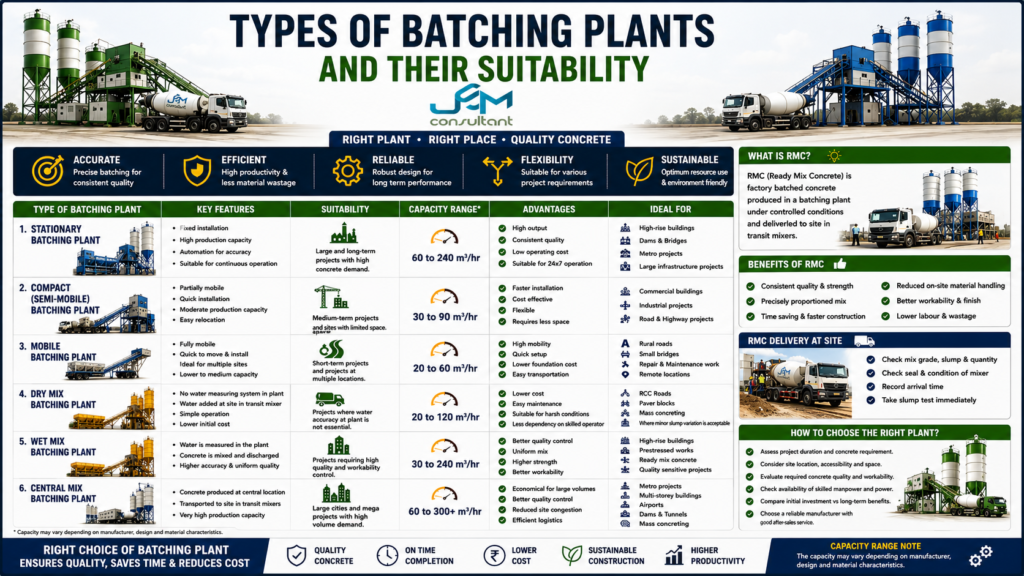
1. Stationary Batching Plant
A Stationary Batching Plant is permanently installed at a fixed location and is ideal for large-scale projects requiring continuous concrete production.
Key Features
- Fixed Installation
- Fully Automated Operation
- High Production Capacity
- Continuous Concrete Supply
Capacity Range
60 to 240 m³/hr
Best Suitable For
- Metro Projects
- Dams
- Bridges
- High-Rise Buildings
- Large Infrastructure Projects
Advantages
✔ High Output
✔ Consistent Quality
✔ Low Operating Cost
✔ Suitable for 24×7 Operations
2. Compact (Semi-Mobile) Batching Plant
Compact batching plants combine mobility and production efficiency, making them suitable for medium-sized construction projects.
Key Features
- Quick Installation
- Easy Relocation
- Moderate Production Capacity
- Space Efficient Design
Capacity Range
30 to 90 m³/hr
Best Suitable For
- Commercial Buildings
- Industrial Projects
- Road Construction
- Highway Projects
Advantages
✔ Cost Effective
✔ Flexible Operations
✔ Faster Setup
✔ Requires Less Space
3. Mobile Batching Plant
Mobile batching plants are designed for projects that require frequent relocation.
Key Features
- Fully Mobile Design
- Fast Installation
- Easy Transportation
- Lower Foundation Requirement
Capacity Range
20 to 60 m³/hr
Best Suitable For
- Rural Roads
- Remote Construction Sites
- Small Bridges
- Maintenance Projects
Advantages
✔ High Mobility
✔ Lower Installation Cost
✔ Quick Setup
✔ Easy Transportation
4. Dry Mix Batching Plant
In a Dry Mix Plant, all ingredients except water are mixed at the batching plant. Water is added inside the transit mixer during transportation.
Key Features
- No Water Mixing at Plant
- Lower Initial Investment
- Simplified Operations
Capacity Range
20 to 120 m³/hr
Best Suitable For
- RCC Roads
- Paver Block Manufacturing
- Mass Concreting Projects
Advantages
✔ Lower Capital Cost
✔ Easy Maintenance
✔ Suitable for Harsh Conditions
✔ Reduced Operational Complexity
5. Wet Mix Batching Plant
In a Wet Mix Plant, all materials including water are mixed within the plant before loading into transit mixers.
Key Features
- Complete Mixing at Plant
- Higher Accuracy
- Better Concrete Quality
Capacity Range
30 to 240 m³/hr
Best Suitable For
- High-Rise Buildings
- Prestressed Structures
- Commercial Projects
- Quality Sensitive Projects
Advantages
✔ Uniform Concrete Quality
✔ Better Workability
✔ Higher Strength
✔ Improved Quality Control
6. Central Mix Batching Plant
Central Mix Plants produce concrete at a central location and transport it to project sites using transit mixers.
Key Features
- Centralized Production
- Very High Capacity
- Superior Quality Control
Capacity Range
60 to 300+ m³/hr
Best Suitable For
- Airports
- Metro Projects
- Mega Infrastructure Projects
- Dams & Tunnels
- Mass Concrete Applications
Advantages
✔ High Productivity
✔ Better Logistics Management
✔ Consistent Quality
✔ Economical for Large Volumes
How to Choose the Right Batching Plant?
Selecting the right batching plant depends on:
Project Size
Small projects may require mobile or compact plants, while large infrastructure projects typically require stationary or central mix plants.
Production Capacity
Estimate daily concrete demand before selecting plant capacity.
Available Space
Compact plants are ideal where land availability is limited.
Budget
Initial investment and operating costs should be evaluated carefully.
Project Duration
Long-term projects justify larger fixed installations.
Concrete Quality Requirements
Wet Mix and Central Mix Plants provide superior quality control.
Why Professional RMC Plant Consulting Matters
Many investors select machinery based solely on price, leading to operational inefficiencies and compliance issues. Professional consultancy helps determine:
- Ideal Plant Type
- Required Capacity
- Land Requirement
- Plant Layout Design
- Utility Planning
- GPCB Approval Requirements
- Factory Licence Requirements
- Machinery Procurement Strategy
Why Choose JSM Consultant?
JSM Consultant provides complete:
- RMC Plant Consulting Gujarat
- RMC Plant Setup Services Gujarat
- Ready Mix Concrete Plant Setup Consultancy
- RMC Plant Layout Design
- RMC Plant Machinery Selection Support
- GPCB Registration for RMC Plant
- Factory Licence Registration
- CGWA NOC Consultancy
- ISO Certification Services
- Government Subsidy Consultancy
We serve clients across Ahmedabad, Gandhinagar, Sanand, Vadodara, Surat, Bharuch, Rajkot, Jamnagar, Morbi, Bhavnagar, Vapi, Anand, and all major industrial locations of Gujarat