Planning to start a Mineral Water Plant in India? Whether you are an entrepreneur, manufacturer, investor, or expanding your existing beverage business, setting up a Packaged Drinking Water Plant is one of the fastest-growing opportunities in the FMCG sector. With increasing awareness about health, hygiene, and safe drinking water, the demand for mineral water bottles, packaged drinking water, and alkaline water continues to rise across residential, commercial, and industrial markets.
At JSM Consultant, we specialize in providing complete Certification Mineral Water Plant including ISO Certification, BIS certification, FSSAI licensing, Factory License, Pollution Control approvals. Our goal is to help you establish a modern, fully compliant, and profitable Water Bottling Plant with confidence.
Why Invest in a Mineral Water Plant Business?
India’s bottled water market has experienced remarkable growth over the past decade, driven by urbanization, increasing disposable income, changing lifestyles, tourism, hospitality, healthcare, and the growing preference for safe packaged drinking water. Consumers today seek hygienically processed, quality-certified water, creating a significant opportunity for businesses entering the industry.
A professionally designed Automatic Water Bottling Plant offers:
- High market demand throughout the year
- Excellent return on investment (ROI)
- Growing opportunities in domestic and export markets
- Low maintenance and scalable operations
- Strong demand from hotels, hospitals, schools, corporate offices, and retail outlets
- Opportunities to diversify into premium products like alkaline water and flavored water
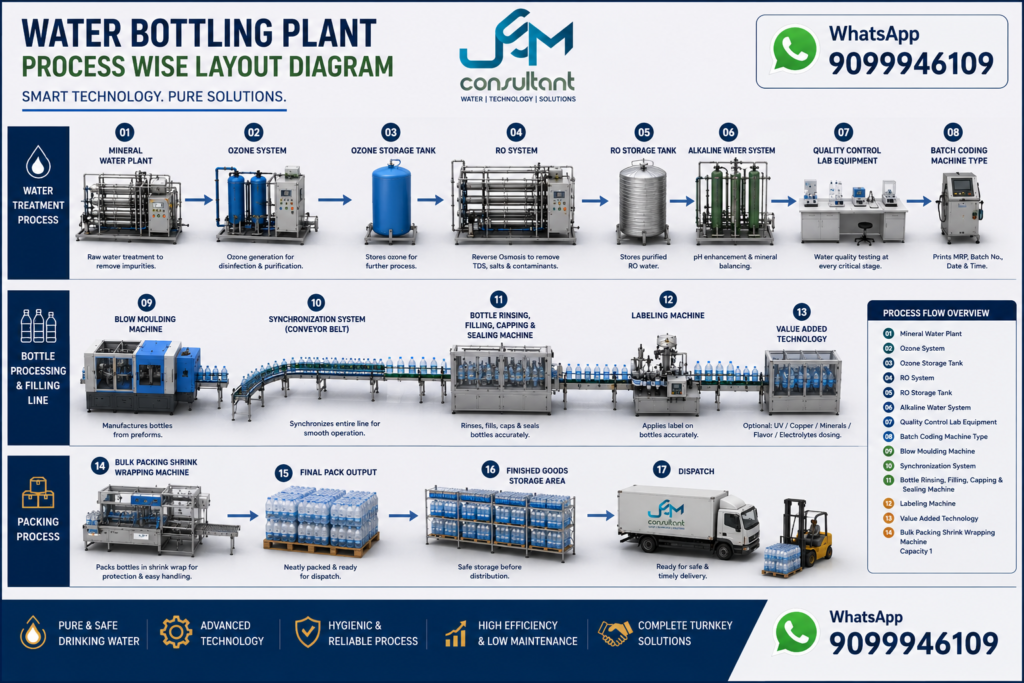
Complete Mineral Water Plant Process Flow
A successful Packaged Drinking Water Plant follows a carefully designed production process to ensure every bottle meets quality and safety standards.
Step 1 – Raw Water Collection
The process begins with collecting raw water from approved sources such as:
- Borewell
- Underground Water
- Municipal Water Supply
- River or Surface Water (subject to treatment)
The quality of the source water determines the treatment process required before bottling.
Step 2 – Raw Water Treatment System
Raw water passes through a multi-stage purification system that removes suspended solids, unpleasant odor, color, and impurities.
Treatment Equipment Includes:
- Multi Grade Sand Filter
- Activated Carbon Filter
- Water Softener
- Micron Cartridge Filter
This stage removes:
- Dust
- Mud
- Sand
- Iron
- Chlorine
- Organic Matter
- Suspended Particles
The result is cleaner water ready for advanced purification.
Step 3 – Ozone Generation System
Ozone is one of the most effective disinfectants used in the bottled water industry.
The Ozone Generator destroys:
- Harmful bacteria
- Viruses
- Microorganisms
- Pathogens
It also improves water quality without leaving harmful chemical residues.
Step 4 – Ozone Contact Tank
After ozonation, water is stored in a specially designed Ozone Storage Tank. This allows sufficient contact time for effective sterilization before entering the Reverse Osmosis system.
Step 5 – Reverse Osmosis (RO) Plant
The RO Plant is the heart of the water purification process.
It removes:
- Total Dissolved Solids (TDS)
- Heavy Metals
- Harmful Chemicals
- Salts
- Fluoride
- Arsenic
- Microbial Contaminants
This produces high-purity drinking water that complies with BIS standards.
Step 6 – RO Storage Tank
Purified water is stored in a food-grade stainless steel tank to maintain hygiene before bottling.
Step 7 – Alkaline Water System (Optional)
With growing consumer demand for premium health products, many manufacturers install an Alkaline Water System.
Benefits include:
- Balanced pH
- Improved taste
- Essential mineral enrichment
- Premium product positioning
- Higher profit margins
Step 8 – Quality Control Laboratory
Quality assurance is essential for every packaged drinking water manufacturer.
Each production batch is tested for:
- pH Value
- TDS
- Conductivity
- Turbidity
- Hardness
- Microbiological Analysis
- Chemical Analysis
Testing ensures compliance with BIS, ISI, and FSSAI regulations.
Bottle Manufacturing Process
Step 9 – PET Blow Moulding Machine
PET preforms are converted into bottles using high-speed automatic blow moulding machines.
Bottle sizes include:
- 200 ml
- 250 ml
- 500 ml
- 1 Litre
- 2 Litre
- 5 Litre
Automatic bottle production reduces costs while maintaining consistent quality.
Step 10 – Automatic Conveyor System
Synchronization conveyors move bottles through every stage of production automatically, minimizing manual handling and maximizing production efficiency.
Benefits include:
- Continuous production
- Reduced labor costs
- Higher productivity
- Improved hygiene
Step 11 – Bottle Rinsing, Filling, Capping & Sealing Machine
This is the most important machine in the production line.
The fully automatic monoblock machine performs:
- Bottle rinsing
- Bottle filling
- Cap placement
- Cap tightening
- Bottle sealing
The entire process is performed in a hygienic enclosed environment.
Step 12 – Automatic Labeling Machine
Labels are applied accurately for:
- Brand Identification
- Product Details
- BIS Mark
- Manufacturing Information
- Marketing Appeal
Professional labeling improves brand visibility on retail shelves.
Step 13 – Batch Coding Machine
Every bottle is printed with:
- Batch Number
- Manufacturing Date
- Expiry Date
- MRP
- Barcode
This provides complete traceability and regulatory compliance.
Step 14 – Value Added Water Technology
To stay competitive, manufacturers can produce premium bottled water products such as:
- Alkaline Water
- Copper Water
- Vitamin Water
- Electrolyte Water
- Oxygen Water
- Herbal Water
- Flavored Water
These products help businesses expand into premium market segments.
Step 15 – Shrink Wrapping & Packaging
The finished bottles are automatically packed using shrink wrapping machines into:
- 12 Bottle Packs
- 24 Bottle Packs
- Customized Bulk Packs
The products are then ready for storage, transportation, and distribution.
Machinery Required for a Mineral Water Plant
A complete Turnkey Water Bottling Plant generally includes:
- Raw Water Treatment Plant
- Reverse Osmosis Plant
- Ozone Generator
- Ozone Contact Tank
- RO Storage Tank
- Alkaline Water System
- PET Blow Moulding Machine
- Air Compressor
- Air Dryer
- Water Chiller
- Bottle Rinsing Filling Capping Machine
- Labeling Machine
- Batch Coding Machine
- Shrink Wrapping Machine
- Automatic Conveyor System
- Stainless Steel Piping
- Electrical Control Panel
- Quality Control Laboratory Equipment
- Utility Equipment
Mineral Water Plant Capacities
JSM Consultant provides complete turnkey solutions for:
- 250 LPH Mineral Water Plant
- 500 LPH Mineral Water Plant
- 1000 LPH Mineral Water Plant
- 2000 LPH Mineral Water Plant
- 4000 LPH Mineral Water Plant
- 6000 LPH Mineral Water Plant
- 10000 LPH Mineral Water Plant
- Customized Industrial Water Bottling Plants
Certifications & Licenses Required
Setting up a Mineral Water Plant requires compliance with statutory regulations.
We provide assistance for:
- BIS Certification (IS 14543 / IS 13428)
- ISI Mark Certification
- FSSAI License
- Factory License
- Pollution Control Board Approval (GPCB/CPCB/SPCB)
- ISO 9001 Certification
- ISO 22000 Food Safety Certification
- HACCP Certification
- GMP Certification
- MSME Registration
- Trade License
- Fire NOC
- Legal Metrology Registration
- Boiler & Electrical Safety Approvals
Why Choose JSM Consultant for Your Water Bottling Plant?
Starting a Mineral Water Plant or Packaged Drinking Water Manufacturing Unit involves much more than purchasing machinery. To operate legally and successfully, businesses must comply with various statutory approvals, quality certifications, and regulatory requirements. At JSM Consultant, we simplify this entire journey by providing end-to-end consultancy, certification, licensing, and turnkey project solutions under one roof.
With years of expertise in the industrial compliance and water treatment sector, we help entrepreneurs, manufacturers, and investors establish fully compliant, efficient, and profitable Water Bottling Plants across India.
Complete Certification & Regulatory Compliance Solutions
Our team offers comprehensive guidance and documentation support to obtain all mandatory certifications and approvals required for setting up and operating a packaged drinking water plant.
✔ BIS Certification Assistance (IS 14543 / IS 13428)
The Bureau of Indian Standards (BIS) certification is mandatory for manufacturing and selling packaged drinking water and natural mineral water in India. We provide complete assistance with documentation, application filing, factory inspection coordination, laboratory testing, and BIS approval to help you achieve compliance smoothly.
✔ ISI Mark Certification
The ISI Mark is a symbol of product quality, safety, and reliability. Our experts guide you through the complete certification process, ensuring your products meet the prescribed Indian Standards before entering the market.
✔ FSSAI License & Registration
Every packaged drinking water manufacturer must obtain an FSSAI License under the Food Safety and Standards Authority of India. We assist with documentation, application submission, compliance requirements, and license approvals for new as well as existing manufacturing units.
✔ Factory License Assistance
Operating a manufacturing facility requires compliance with the Factories Act and related state regulations. Our team manages the complete Factory License application process, ensuring your plant fulfills all statutory requirements before production begins.
✔ ISO Certification
Enhance your company’s credibility and operational excellence with internationally recognized ISO certifications. We provide consultancy and certification assistance for:
- ISO 9001 – Quality Management System
- ISO 22000 – Food Safety Management System
- HACCP Certification
- GMP Certification
- Other industry-specific ISO standards
These certifications improve product quality, customer confidence, and business opportunities in domestic as well as international markets.
✔ Pollution Control Board Approval (GPCB / CPCB / SPCB)
Environmental compliance is an essential requirement for every manufacturing unit. We assist businesses in obtaining:
- Consent to Establish (CTE)
- Consent to Operate (CTO)
- Pollution Control Board Registration
- Environmental compliance documentation
Whether your project falls under GPCB, CPCB, or any State Pollution Control Board, our experts ensure a hassle-free approval process.